Why Bellingham Was Not Sent Off: FIFA Rule Explained
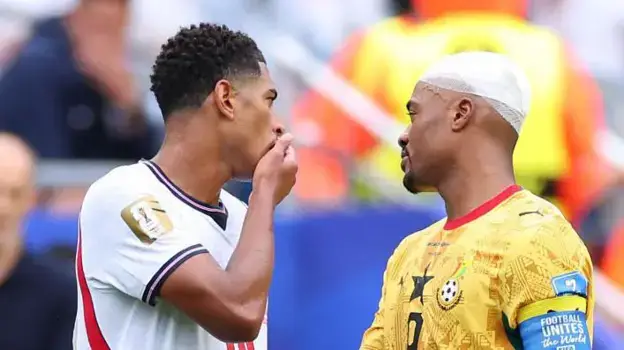
Why Bellingham Was Not Sent Off became one of the biggest talking points after England’s goalless draw against Ghana at the 2026 FIFA World Cup. Fans around the world were confused after seeing England midfielder Jude Bellingham cover his mouth while speaking to Ghana captain Jordan Ayew during the match in Boston.
The moment quickly went viral on social media because FIFA recently introduced a controversial rule regarding players covering their mouths during conversations on the pitch. Under the updated law for the 2026 World Cup, a player can receive a red card if they hide their mouth while speaking during a confrontation with an opponent.
Because of this new regulation, many supporters expected VAR to review the incident and possibly send Bellingham off. However, no red card was given. So why did the referee allow play to continue?
Why Bellingham Was Not Sent Off During England vs Ghana
The simple answer is context.
The new FIFA law does not ban covering the mouth entirely. Instead, it targets situations where a player hides their mouth while engaging in a heated or confrontational exchange.
In Bellingham’s case, there was no visible aggression between him and Jordan Ayew. The two players appeared calm and were simply having a conversation.
This distinction is extremely important.
FIFA’s head of referees, Pierluigi Collina, explained before the tournament that players are still allowed to cover their mouths in normal conversations.
According to Collina, footballers often cover their mouths while chatting because they do not want cameras or lip readers to capture private conversations. That behavior alone is not illegal.
The punishment applies only when the act happens during a confrontation or aggressive incident.
The New FIFA Mouth-Covering Rule
The rule was introduced after growing concern over abusive language and hidden insults on the pitch.
FIFA president Gianni Infantino strongly supported the law change, arguing that players should be more accountable for what they say during matches.
The controversy increased after Benfica winger Gianluca Prestianni received a six-match suspension from UEFA following homophobic abuse directed toward Vinícius Júnior during a Champions League game.
That incident highlighted a major problem in modern football: offensive language can be difficult to detect when players intentionally hide their mouths.
FIFA believed the new law would discourage abusive speech and improve player conduct.
The message from football authorities was clear: if a player covers their mouth during a heated confrontation, officials may interpret that as an attempt to hide inappropriate language.
That can lead to a direct red card.
Why VAR Did Not Intervene Against Bellingham
VAR reviews all potential red-card incidents during matches.
Since Bellingham covered his mouth while speaking to Ayew, some fans expected video officials to intervene.
However, VAR also considers the emotional context of each incident.
In the England vs Ghana match, there was:
- No physical altercation
- No pushing or aggressive body language
- No surrounding melee
- No signs of hostility
Because the exchange appeared peaceful, VAR found no reason to recommend a red card.
This explains why Why Bellingham Was Not Sent Off became a debate mostly among fans rather than referees.
From the officials’ perspective, the case was straightforward.
Why Miguel Almiron Received a Red Card
To understand why Bellingham stayed on the pitch, it helps to compare his case with Miguel Almirón.
Almiron became the first player sent off under this new FIFA rule during Paraguay’s match against Turkey.
The key difference was the atmosphere of the match.
The incident started after Paraguay striker Isidro Pitta went down claiming a dangerous challenge from Turkey’s Ismail Yuksek.
That challenge triggered chaos.
Players from both teams rushed in, tempers rose, and a heated confrontation followed.
During that tense moment, Almiron covered his mouth while speaking to Turkey defender Mert Muldur.
Although Almiron did not appear physically aggressive, the surrounding context mattered.
The match had become highly emotional.
Officials viewed his mouth-covering as suspicious because it happened during an intense confrontation.
VAR reviewed the incident and advised a red card.
That decision made Almiron the first footballer dismissed under the new rule.
Context Is Everything
The biggest lesson from these incidents is simple: context matters more than the action itself.
Covering the mouth is not automatically punishable.
A player can still do it during:
- Friendly conversations
- Tactical discussions
- Casual exchanges before or after matches
- Conversations with teammates
Problems arise when mouth-covering happens during conflict.
This is why Bellingham’s incident and Almiron’s incident were treated differently.
One happened during a calm discussion.
The other happened during a volatile confrontation.
That difference explains everything.
Gianni Infantino’s View on the Rule
Infantino has strongly defended the law.
He believes football should set a positive example for young fans.
According to him, players should not hide their words.
His logic is straightforward: if a player has nothing inappropriate to say, there is no need to hide their mouth.
Supporters of the rule argue it promotes transparency and respect.
They believe abusive language has been ignored for too long.
By punishing suspicious behavior, FIFA hopes to reduce verbal abuse.
Criticism of the Rule
Not everyone agrees with FIFA.
Many analysts believe the rule is difficult to enforce consistently.
One major criticism is subjectivity.
How can referees reliably determine whether a conversation is friendly or confrontational?
That judgment can vary from one official to another.
Another concern is possible abuse.
Players could manipulate the rule to get opponents sent off.
For example, a player might exaggerate an interaction and immediately alert the referee after seeing an opponent cover their mouth.
That creates room for gamesmanship.
Some experts believe this makes the rule dangerous.
Could Domestic Leagues Adopt This Rule?
Currently, the rule is optional.
Competitions can choose whether to use it.
So far, it has only been implemented at the 2026 FIFA World Cup.
Domestic leagues such as the Premier League, La Liga, and Serie A have not adopted it.
Many league officials are likely waiting to see whether FIFA can apply the rule consistently.
If controversy continues, some leagues may avoid using it altogether.
Final Verdict on Why Bellingham Was Not Sent Off
So, why was Jude Bellingham not sent off?
Because he did not break the rule.
The law does not prohibit mouth-covering by itself.
It punishes players only when that action occurs during confrontational exchanges.
Bellingham’s interaction with Jordan Ayew showed no aggression, hostility, or conflict.
VAR reviewed the context and saw no reason for punishment.
That is why the referee allowed him to remain on the field.
Even though the moment sparked widespread debate online, FIFA’s interpretation of the law was consistent in this case.
As the 2026 World Cup continues, expect more discussions around this controversial rule.
For now, one thing is clear: Why Bellingham Was Not Sent Off has everything to do with context, not just the action itself.