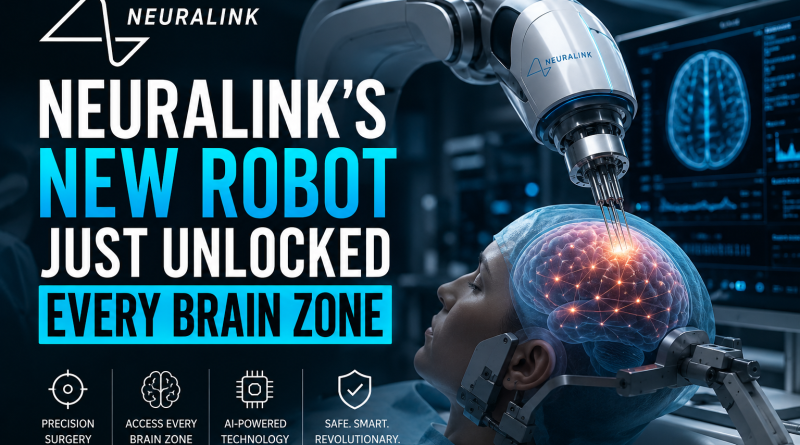
What Shocking Breakthrough?: Neuralink’s New Robot Just Unlocked Every Brain Zone
Introduction
“The future of medicine may not only be in drugs or surgery—but in direct communication with the human brain.”
Neuralink, brain-computer interface company founded by Elon Musk, has once again captured global attention with a groundbreaking announcement. The company unveiled a new surgical robot that can reportedly access virtually every region of the human brain. This development could dramatically change how neurological disorders are treated in the future of Neuralink’s New Robot Just Unlocked Every Brain Zone.
For years, scientists have worked toward building systems that connect the human brain directly to computers. Neuralink’s latest robot appears to push that vision much closer to reality. Rather than focusing only on helping paralyzed individuals move digital cursors, this new robot expands possibilities to treat complex brain conditions such as Parkinson’s disease, epilepsy, depression, and even speech disorders.
The phrase “Neuralink’s New Robot Just Unlocked Every Brain Zone” sounds dramatic, but it reflects a major technological leap. If the robot can safely reach almost any area in the brain, researchers may be able to stimulate or read signals from regions previously difficult to access.
What Is Neuralink’s New Robot?
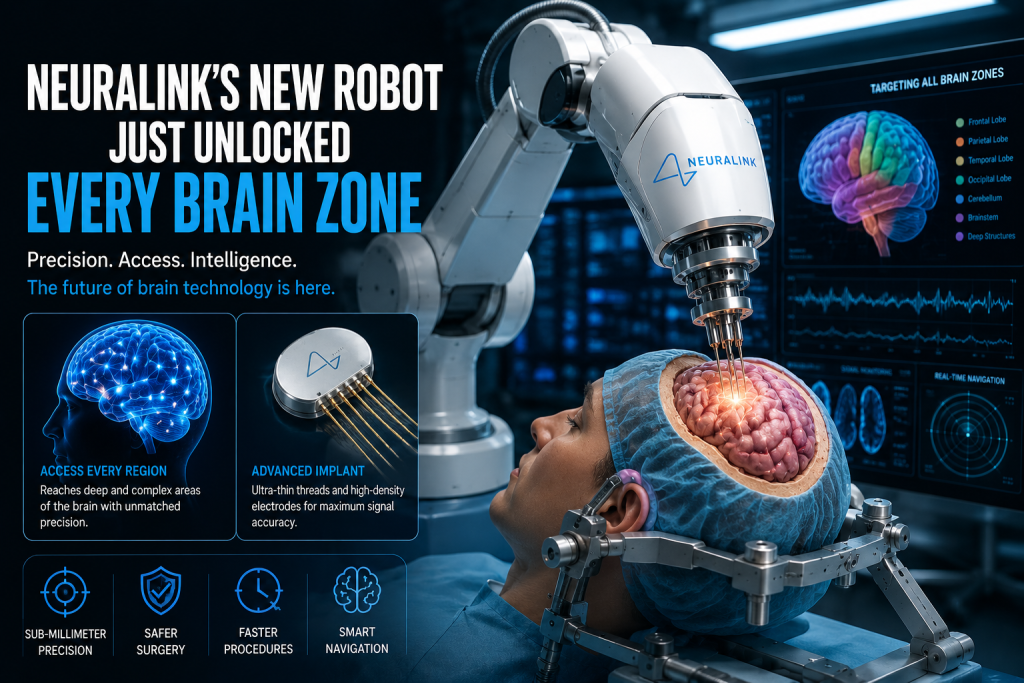
Neuralink’s new robot is a highly advanced surgical machine designed to implant ultra-thin electrode threads into the brain with extraordinary precision. These threads are thinner than human hair and are almost impossible for human hands alone to place accurately.
The robot solves this challenge using multiple cameras, real-time imaging, and robotic precision systems. It carefully inserts electrodes while avoiding blood vessels and sensitive tissue.
Unlike traditional neurosurgery, where surgeons manually perform delicate procedures, Neuralink’s robot automates much of the implantation process. This reduces human error and increases speed.
According to company updates, the robot can compensate for tiny brain movements caused by:
- Heartbeat
- Breathing
- Blood circulation
This matters because even microscopic movement can affect placement accuracy.
Why “Every Brain Zone” Matters
The biggest breakthrough is not simply automation—it is accessibility.
Previous systems had limitations regarding where electrodes could be implanted. Certain areas of the brain were difficult or risky to reach.
Neuralink’s new robot changes that.
By accessing almost any brain region, doctors may eventually target specific neurological problems more effectively.
Examples include:
Parkinson’s Disease
Parkinson’s affects movement and motor control. If Neuralink can stimulate affected regions precisely, symptoms such as tremors may be reduced.
Epilepsy
Epileptic seizures originate in abnormal brain activity. A brain implant could potentially detect seizure patterns before they happen and intervene instantly.
Depression
Treatment-resistant depression remains difficult to manage. Some researchers believe targeted brain stimulation may offer better outcomes.
Paralysis
Neuralink already demonstrated that paralyzed patients can control computers using thought alone. Greater brain access may improve speed and control.
How the Robot Works
Neuralink’s surgical robot combines several cutting-edge technologies.
1. High-Precision Cameras
The robot uses multiple cameras to create a detailed view of the surgical field. These cameras help identify safe insertion paths.
2. AI-Assisted Navigation
Artificial intelligence helps determine where electrodes should be placed for maximum effectiveness.
3. Robotic Thread Insertion
The machine inserts flexible threads into brain tissue with sub-millimeter precision.
4. Real-Time Adjustments
Because the brain constantly moves slightly, the robot continuously adapts during surgery.
This combination makes the process faster, safer, and scalable.
Neuralink’s Goal Beyond Paralysis
Initially, Neuralink focused on helping people with severe paralysis regain digital control.
That goal remains important.
However, the company’s ambitions have expanded.
Elon Musk has repeatedly described a long-term vision where humans can interact with computers using thoughts alone.
This includes possibilities like:
- Thought-based communication
- Robotic limb control
- Restoring speech
- Memory assistance
- Sensory restoration
Some future concepts even involve brain-to-brain communication, though such applications remain highly experimental.
Human Trials Are Accelerating
Neuralink has moved beyond theory.
Human trials are already underway.
Early trial participants have shown impressive results. Some individuals with paralysis have successfully used implants to:
- Move computer cursors
- Browse the internet
- Play games
- Communicate digitally
This is a major proof of concept.
Reports indicate the number of implanted patients has grown significantly as the company scales operations. Neuralink aims to expand from small trials toward larger clinical deployment.
The Future of Automated Brain Surgery
One of Neuralink’s biggest goals is mass adoption.
Traditional neurosurgery is expensive, slow, and highly specialized.
Neuralink wants to change that.
The company aims to make implantation as routine as laser eye surgery someday.
That means:
- Faster procedures
- Lower costs
- Higher patient volume
- Wider medical access
Automation is essential for this vision.
Without robotic assistance, scaling brain implant surgery to thousands of patients would be extremely difficult.
Ethical Concerns Around Brain Implants
Not everyone is comfortable with this technology.
Brain implants raise serious ethical questions.
Some major concerns include:
Privacy
Who owns neural data?
Brain signals may reveal highly personal information.
Security
Can brain implants be hacked?
As devices become connected, cybersecurity becomes critical.
Consent
What protections exist for vulnerable patients?
Enhancement vs Treatment
Should implants only treat illness—or enhance healthy humans too?
These questions will shape how society adopts neurotechnology.
“The greatest technological breakthroughs often create the hardest ethical questions.”
Competition in Brain-Computer Interfaces
Neuralink is not alone.
Several companies and research groups are racing to build advanced brain-computer interfaces.
Competitors are exploring:
- Speech decoding
- Non-invasive interfaces
- Brain signal translation
- AI-assisted neural interpretation
Some experts argue competitors are ahead in speech restoration, while Neuralink leads in robotic implantation. The race is becoming intense worldwide.
Could This Change Humanity Forever?
Possibly.
If Neuralink succeeds, brain-computer interfaces could transform healthcare and human capability.
Imagine a future where someone with paralysis walks again through robotic assistance.
Imagine stroke patients regaining speech.
Imagine thought-based communication happening instantly.
This technology remains early-stage, but the trajectory is extraordinary.
Neuralink’s new robot may represent the turning point.
By unlocking access to nearly every brain zone, the company has expanded what scientists believe is possible.
Conclusion
Neuralink’s latest surgical robot is more than just an engineering achievement—it could redefine modern medicine.
Its ability to reach almost every brain zone opens new possibilities for treating devastating neurological conditions such as Parkinson’s, epilepsy, paralysis, and depression.
While challenges remain in safety, ethics, and regulation, the breakthrough signals a powerful future for brain-computer interfaces.
The question is no longer whether humans can connect brains to machines.
The real question is:
“How far will this connection reshape the future of humanity?”
As Neuralink continues pushing boundaries, the world watches closely.